
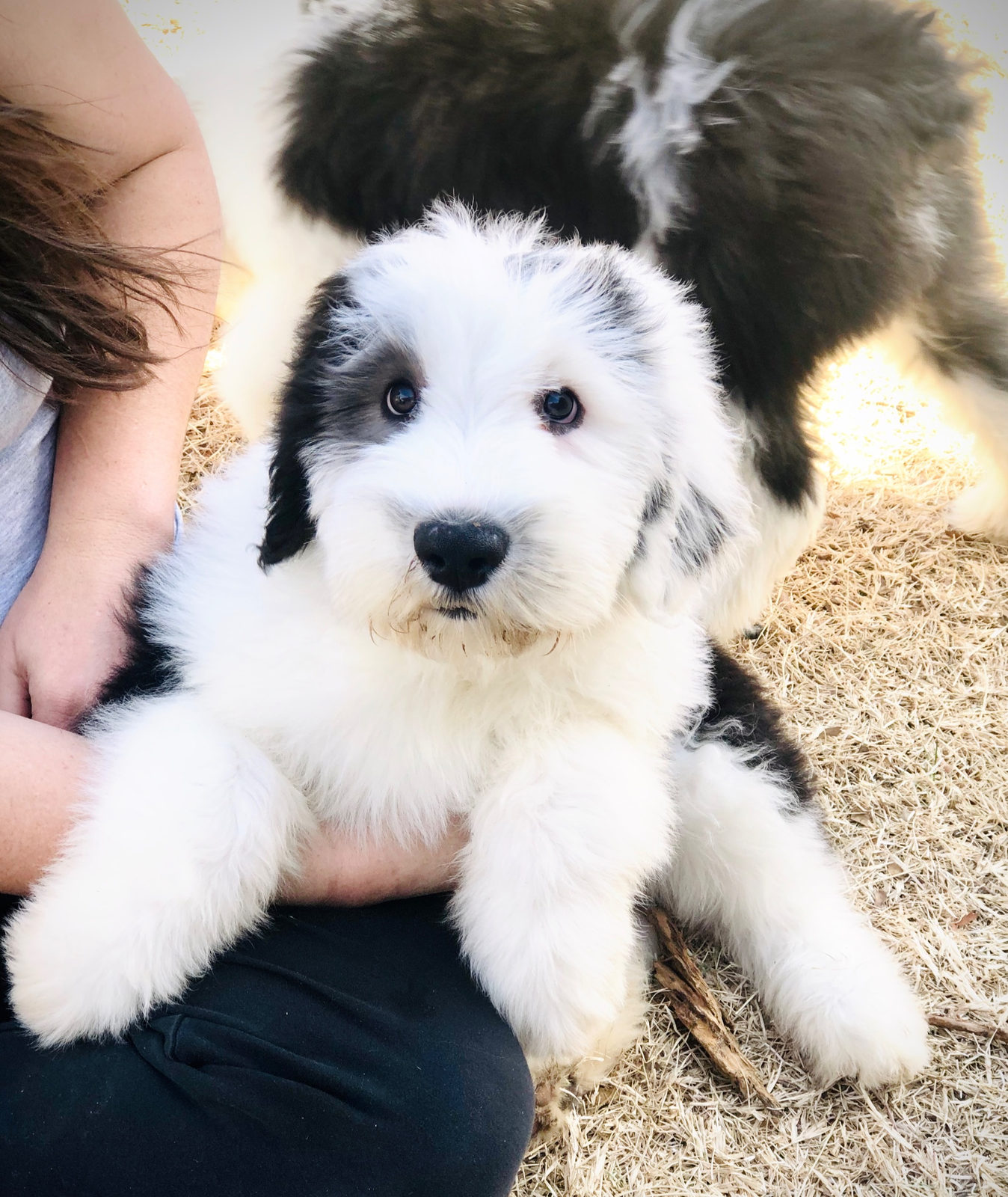
Feeding questions come up constantly with a new puppy: how much, how often, and which food actually matters. Here’s a practical breakdown by age and size, along with the two things that matter most for this specific breed — large-breed nutrition and bloat prevention.
How Much to Feed a Sheepadoodle Puppy
Puppies need more frequent, calorie-dense meals than adults to support rapid early growth.
| Age | Meals Per Day | Approx. Portion |
|---|---|---|
| 8–12 weeks | 4 | 8–10% of body weight daily, split across meals |
| 3–6 months | 3–4 | Gradually reducing percentage as weight increases |
| 6–12 months | 2–3 | Transitioning toward adult portion sizes |
| 12–24 months | 2 | Adult portions, still on large-breed formula until growth plates close |
A good visual check regardless of the chart: your puppy’s ribs should be easy to feel but not visibly sticking out, with a slight waist tuck when viewed from above.

Ribs that are easy to feel but not visible is a reliable, breed-independent way to judge portion size.
Adult Feeding Guidelines
| Size Class | Approx. Daily Amount | Meals Per Day |
|---|---|---|
| Micro / Mini | 1.5–2.5 cups | 2 |
| Medium | 2.5–3.5 cups | 2 |
| Standard | 3–4.5 cups | 2 |
These figures are starting points, not fixed rules — activity level, metabolism, and the specific food’s calorie density all shift the right amount for an individual dog. Free-feeding (leaving food out all day) isn’t recommended for this breed, partly because portion control matters and partly because of the bloat considerations below.
What “Complete and Balanced” Actually Means
Not all dog food labels mean the same thing. According to AAFCO (the Association of American Feed Control Officials), a food can only be labeled “complete and balanced” for a specific life stage if it meets defined nutrient minimums, either through lab analysis or feeding trials. Foods labeled “for all life stages” must meet both the growth (puppy) and adult maintenance standards, which are the most demanding option nutritionally.
Checking for an AAFCO statement on the label is one of the simplest ways to confirm a food meets baseline nutritional standards, regardless of brand or price point.

Checking for an AAFCO nutritional adequacy statement is a quick way to verify any food’s baseline standards.
Choosing a Large-Breed Formula
Even mini and micro Sheepadoodles often benefit from a large-breed puppy formula, and standard-sized puppies genuinely need one. According to the American Kennel Club, large-breed puppy foods are formulated with controlled calcium and phosphorus levels to support slower, steadier bone growth — growing too fast on standard puppy food can increase the risk of skeletal issues in bigger dogs.
- Look for named meat sources (chicken, lamb, salmon) rather than vague “meat meal” or plant-protein fillers.
- Check the calcium-to-phosphorus ratio if your puppy is on the larger end of the size spectrum.
- Stay on large-breed puppy food until growth plates close, typically 12 to 18 months depending on final adult size.
Reducing Bloat Risk
Bloat (gastric dilatation-volvulus, or GDV) is a serious, fast-developing emergency in deep-chested breeds, and Sheepadoodles inherit some of that risk from both the Old English Sheepdog and Standard Poodle sides. A few feeding habits meaningfully lower the risk:
- Feed smaller, more frequent meals rather than one large daily portion.
- Use a slow-feeder bowl if your dog tends to gulp food quickly.
- Avoid vigorous exercise for at least an hour before and after meals.
- Elevate feeding, or not, based on your vet’s guidance — this one is genuinely debated in veterinary literature, so ask your vet directly rather than assuming either approach is safer.

Smaller, more frequent meals and slower eating both help reduce bloat risk in deep-chested breeds.
Human Foods to Avoid
It’s tempting to share table scraps with an eager, food-motivated dog, but several common foods are genuinely dangerous for Sheepadoodles:
Generally Safe in Moderation
- Plain cooked chicken or turkey
- Carrots, green beans, blueberries
- Plain pumpkin puree
- Small amounts of plain rice
Never Feed
- Chocolate, grapes, and raisins
- Onions, garlic, and chives
- Xylitol (common in sugar-free gum and some peanut butters)
- Cooked bones, which can splinter
If you suspect your dog has eaten something on the “never feed” list, contact your veterinarian or an animal poison control hotline immediately rather than waiting to see if symptoms appear.

Even food-motivated Sheepadoodles should stick to dog-safe treats rather than table scraps that can contain hidden dangers.
Transitioning Between Foods
Whether you’re switching from puppy to adult food, or just changing brands, a gradual transition over 7 to 10 days helps avoid digestive upset. A simple approach: mix 25% new food with 75% old for a few days, move to 50/50, then 75/25, before fully switching.
Watch for loose stool or reduced appetite during any transition, and slow the process down further if you notice either. Sheepadoodles generally have resilient digestion, but rushing a food change is one of the most common avoidable causes of an upset stomach.

A slow, gradual transition over a week or more helps avoid digestive upset when switching foods.
Questions About Feeding a Sunshine Sheepadoodles Puppy?
We’re happy to talk through what your specific puppy has been eating and how to transition smoothly.
Contact Sunshine SheepadoodlesFrequently Asked Questions
How many cups of food does an adult Sheepadoodle need?
It varies by size class, roughly 1.5 to 2.5 cups daily for mini/micro sizes and 3 to 4.5 cups for standard sizes, split across two meals. Activity level and the specific food’s calorie density shift this range.
Should Sheepadoodles eat large-breed puppy food?
Standard-sized Sheepadoodles generally should, and many mini/micro Sheepadoodles benefit too, since large-breed formulas control calcium and phosphorus levels to support healthier bone growth.
Is grain-free food better for Sheepadoodles?
Not necessarily. Grain-free isn’t inherently healthier, and some research has raised questions about a possible link between certain grain-free diets and heart issues in dogs. Discuss any specific dietary choice with your veterinarian.
How do I know if my Sheepadoodle is at a healthy weight?
You should be able to easily feel (but not see) the ribs, and there should be a visible waist tuck when viewed from above. Your veterinarian can also assess body condition score at routine visits.
Curious how nutrition connects to overall health? See our Sheepadoodle lifespan and health guide, or review our puppy training guide for the first-month routine feeding fits into. Portion amounts are only half the picture, though; for a full walkthrough of checking body condition by feel under a thick coat, see our Sheepadoodle weight management and body condition guide.