
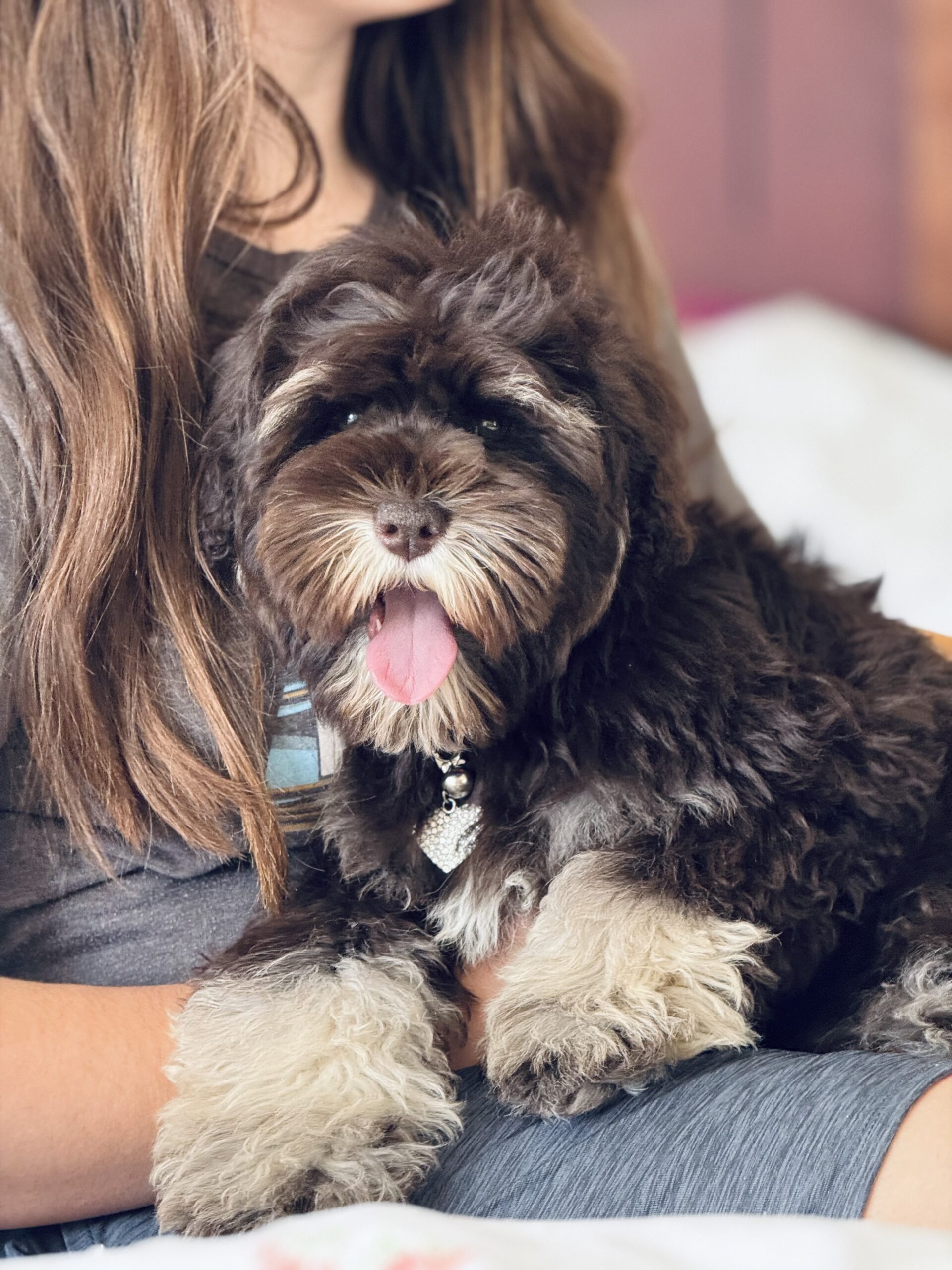
Sheepadoodles and Goldendoodles are two of the most popular Poodle-mix breeds, and it’s easy to see why people cross paths between the two while researching. Both are shaggy, affectionate, low-shedding family dogs — but the parent breed behind each one shapes some real differences worth knowing before you decide.
If you’ve narrowed your search down to these two, you’re already asking the right question. The short version: both breeds share more similarities than differences, and the choice usually comes down to a handful of specific factors covered below rather than one breed being universally “better.”
Sheepadoodle vs. Goldendoodle: At a Glance
| Category | Sheepadoodle | Goldendoodle |
|---|---|---|
| Non-Poodle Parent | Old English Sheepdog | Golden Retriever |
| Typical Coat | Wavy to shaggy, black & white common | Wavy to curly, gold/apricot common |
| Standard Size (adult) | 55–85+ lbs | 50–90 lbs |
| Mini Size (adult) | 25–45 lbs | 15–35 lbs |
| Energy Level | High, often described as slightly calmer as adults | High, sustained playful energy |
| Temperament | Loyal, protective, people-focused | Sociable, outgoing, eager to please |
| Trainability | High | High |
| Shedding | Low (varies by generation) | Low (varies by generation) |
| Grooming Frequency | Every 6–8 weeks | Every 6–8 weeks |
Appearance & Coat
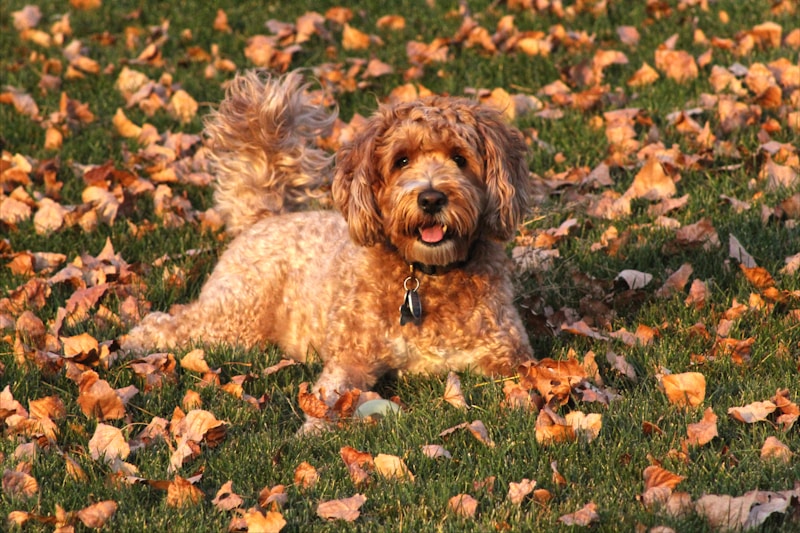
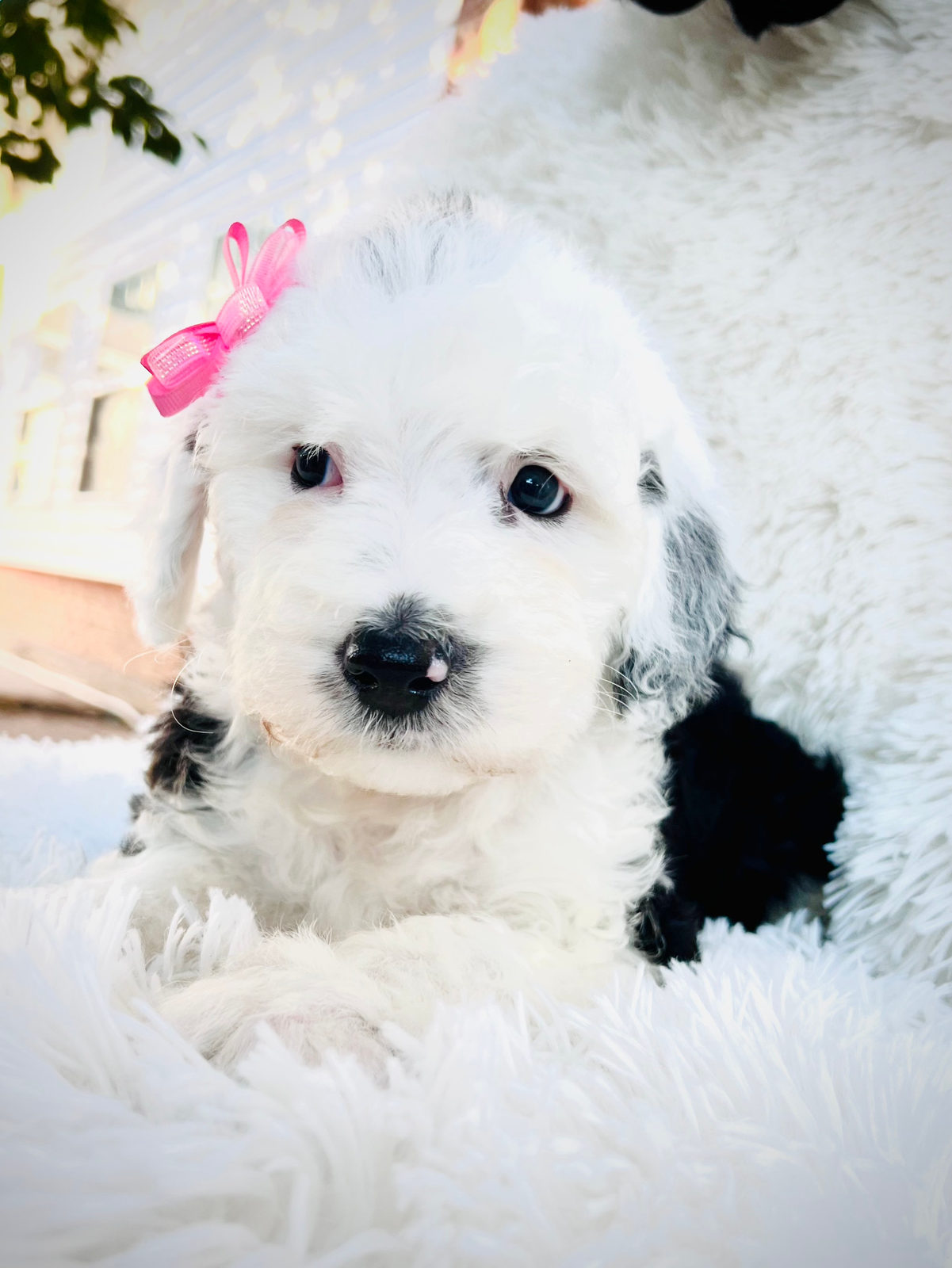
The clearest visual difference comes from the non-Poodle parent. A Sheepadoodle’s Old English Sheepdog side tends to produce a shaggier, more “sheepdog” look, most commonly in black and white. A Goldendoodle’s Golden Retriever side leans toward the classic gold, apricot, or cream “teddy bear” coloring most people associate with the breed.

Goldendoodles typically carry the gold or apricot coloring inherited from their Golden Retriever parent.
Temperament & Energy Level
Both breeds are affectionate and people-oriented, but the emphasis differs slightly. Sheepadoodles tend to be more protective and watchful, a trait from the Old English Sheepdog’s herding and guarding background. Goldendoodles tend to be more universally friendly and outgoing, reflecting the Golden Retriever’s famously easygoing nature.
Neither breed is aggressive by nature, and both need daily exercise and mental stimulation. If you want a dog that’s a little more reserved with strangers but deeply bonded to its family, a Sheepadoodle often fits that description slightly better. If you want a dog that greets every person and dog like a long-lost friend, a Goldendoodle often leans that direction.

Sheepadoodles tend to be slightly more watchful and protective than the typically outgoing Goldendoodle.
Size & Growth
Both breeds come in mini and standard sizes, driven by which size Poodle was used in the cross, and the ranges overlap quite a bit. Standard Sheepadoodles run slightly heavier on average than standard Goldendoodles, while mini Goldendoodles can run a bit smaller than mini Sheepadoodles. Neither difference is large enough to be a deciding factor on its own — ask any specific breeder about their line’s typical adult size.
Growth timelines are also similar: both breeds reach adult height somewhere around 9 to 12 months for mini sizes, and 16 to 18 months for standard sizes, with the final year mostly spent filling out muscle and coat rather than growing taller. If precise adult size matters to your household, our Sheepadoodle size guide breaks this down in more detail by size class.
Grooming & Shedding
Both breeds are low-shedding compared to their non-Poodle parent, and both need comparable grooming commitments: brushing several times a week and professional grooming roughly every 6 to 8 weeks. Neither breed is truly hypoallergenic (no dog is), but both are commonly chosen by people managing mild to moderate dog allergies. Our Sheepadoodle hypoallergenic guide covers how coat generation affects shedding in more detail.
Grooming needs are broadly similar between the two breeds, regardless of coat color.
Health Considerations
As crossbreeds, both Sheepadoodles and Goldendoodles generally benefit from hybrid vigor compared to some purebred lines, but neither is immune to health issues carried by their parent breeds. Goldendoodles can inherit conditions associated with Golden Retrievers, including certain eye and joint conditions. Sheepadoodles can inherit conditions associated with Old English Sheepdogs, including hip dysplasia.
Whichever breed you’re considering, ask the breeder directly what health testing was done on both parents — that matters more than the breed name itself. Reputable breeders of either mix should be able to share hip, elbow, and eye clearances for the parent dogs without hesitation.
Asking about parent health testing matters more than the breed name, regardless of which doodle you choose.
Which One Fits Your Lifestyle?
Consider a Sheepadoodle If
- You want a dog that’s deeply bonded and a bit protective of the family
- You like the classic shaggy sheepdog look
- You don’t mind a slightly more independent streak occasionally
Consider a Goldendoodle If
- You want a dog that’s outgoing with everyone it meets
- You prefer the classic gold/apricot “teddy bear” look
- You want a breed with an especially long track record of family-friendliness
According to the Goldendoodle Association of North America, a well-bred Goldendoodle should be friendly, trustworthy, and stable in temperament — a standard that maps closely onto what responsible Sheepadoodle breeders aim for as well. In practice, the biggest difference between the two often comes down to personal preference on looks and slight temperament tendencies, not one being objectively “better” than the other.
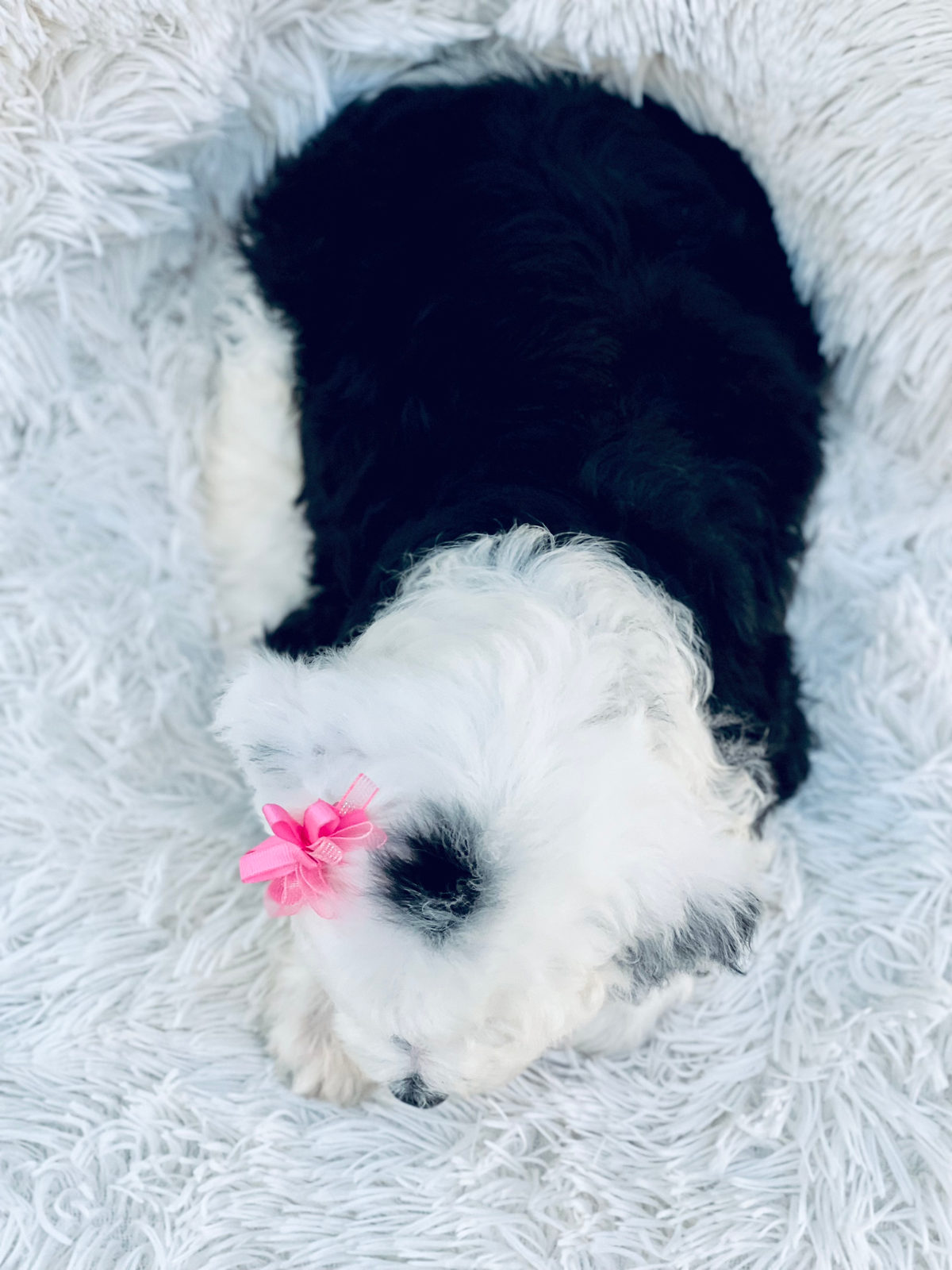
Whichever breed you choose, temperament and health testing matter more than coat color alone.
Meet a Sheepadoodle in Person
The best way to know which breed fits your family is to spend time with one. See our current litters and reach out with questions.
View Available PuppiesFrequently Asked Questions
Which is calmer, a Sheepadoodle or a Goldendoodle?
Sheepadoodles are sometimes described as slightly calmer once they reach adulthood, though both breeds are high-energy through puppyhood and adolescence. Individual temperament varies more than breed generalizations suggest.
Do Sheepadoodles or Goldendoodles shed less?
Shedding in both breeds depends more on generation (F1 vs. F1B) and coat type than on which breed you choose. Neither is guaranteed to be lower-shedding than the other across the board.
Are Sheepadoodles bigger than Goldendoodles?
Standard Sheepadoodles tend to run slightly heavier on average than standard Goldendoodles, though both breeds have overlapping size ranges depending on the specific Poodle parent used.
Which breed is easier to train?
Both breeds are highly trainable thanks to their Poodle genetics. Goldendoodles are often described as slightly more eager-to-please, while Sheepadoodles can show more independence, though this varies by individual dog.
Curious how Sheepadoodle sizing compares across categories? See our Sheepadoodle size guide, or learn more about Sheepadoodle temperament in depth.
Leave a Reply