Category: Sheepadoodle Guide

Educational guides about sheepadoodle sizes, temperament, coat, and care from Sunshine Sheepadoodles.

  • How to Reserve a Puppy from Sunshine Sheepadoodles: What to Expect

    How to Reserve a Puppy from Sunshine Sheepadoodles: What to Expect

    Sheepadoodle Guide · Sunshine Sheepadoodles

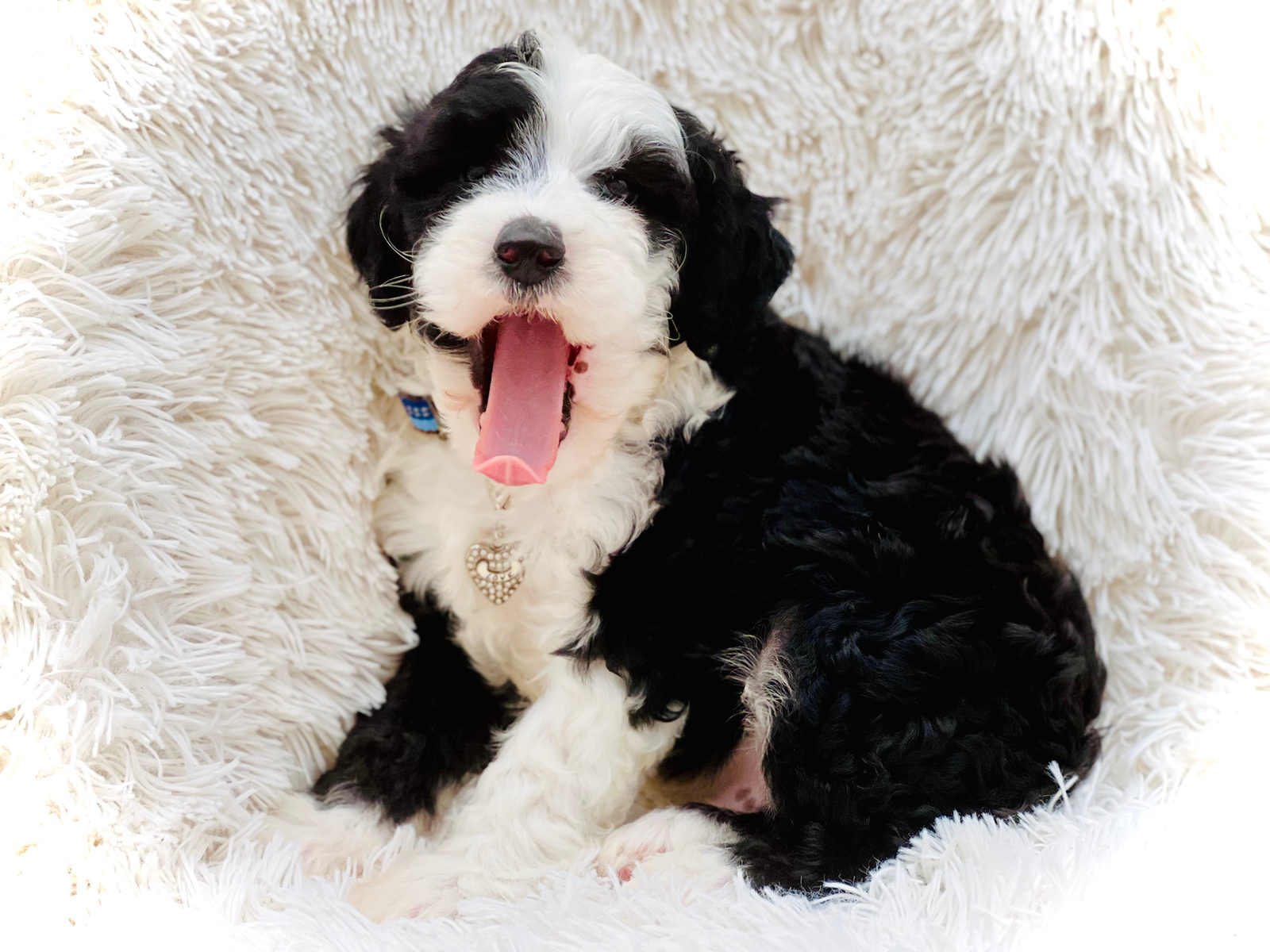
    Sheepadoodle puppy ready to go home with new family

    If you’ve decided a Sheepadoodle is the right fit and you’re ready to move forward, the process of actually reserving a puppy can feel like a mystery. Here’s exactly how it works with us, plus general guidance on what to ask any breeder before you commit.

    Step 1: Call or Email to Request an Application

    The process starts with a simple first step: call or email us to request an application. We’re happy to answer any questions along the way, whether you’re set on a specific litter or still deciding if the timing is right.

    There’s no pressure in that first conversation. Some families reach out months before a litter is even planned just to ask questions and get on our radar; others reach out the moment they see an available puppy that catches their eye. Either approach is completely fine.

    You can also reach us directly through our contact page. However you reach out, expect a real conversation rather than a form-letter response — we’d rather talk through whether a Sheepadoodle, and specifically one of our puppies, is genuinely the right fit before anything moves forward.

    Family reaching out to inquire about sheepadoodle puppy reservation

    Reaching out by phone or email is the first step toward reserving a puppy.

    Availability & Timing

    We keep our program small and intentional, with only two litters a year, so availability genuinely varies. If a specific litter isn’t quite what you’re looking for, it’s worth checking back or letting us know what you’re hoping for so we can keep you in mind. Our available puppies page always reflects the current litter.

    How Our Puppies Are Raised Before They Go Home

    Every litter is family raised in our home and socialized from a very early age, so puppies grow up calm, confident, and comfortable around people. By the time a puppy is ready to go home, here’s what’s already been done:

    What’s completed before a Sunshine Sheepadoodles puppy goes home
    MilestoneStatus
    Litter trainedComplete
    Crate trainedComplete
    Potty trainedComplete
    VaccinatedCurrent on age-appropriate vaccines
    MicrochippedComplete
    Early socializationOngoing from birth, in our home
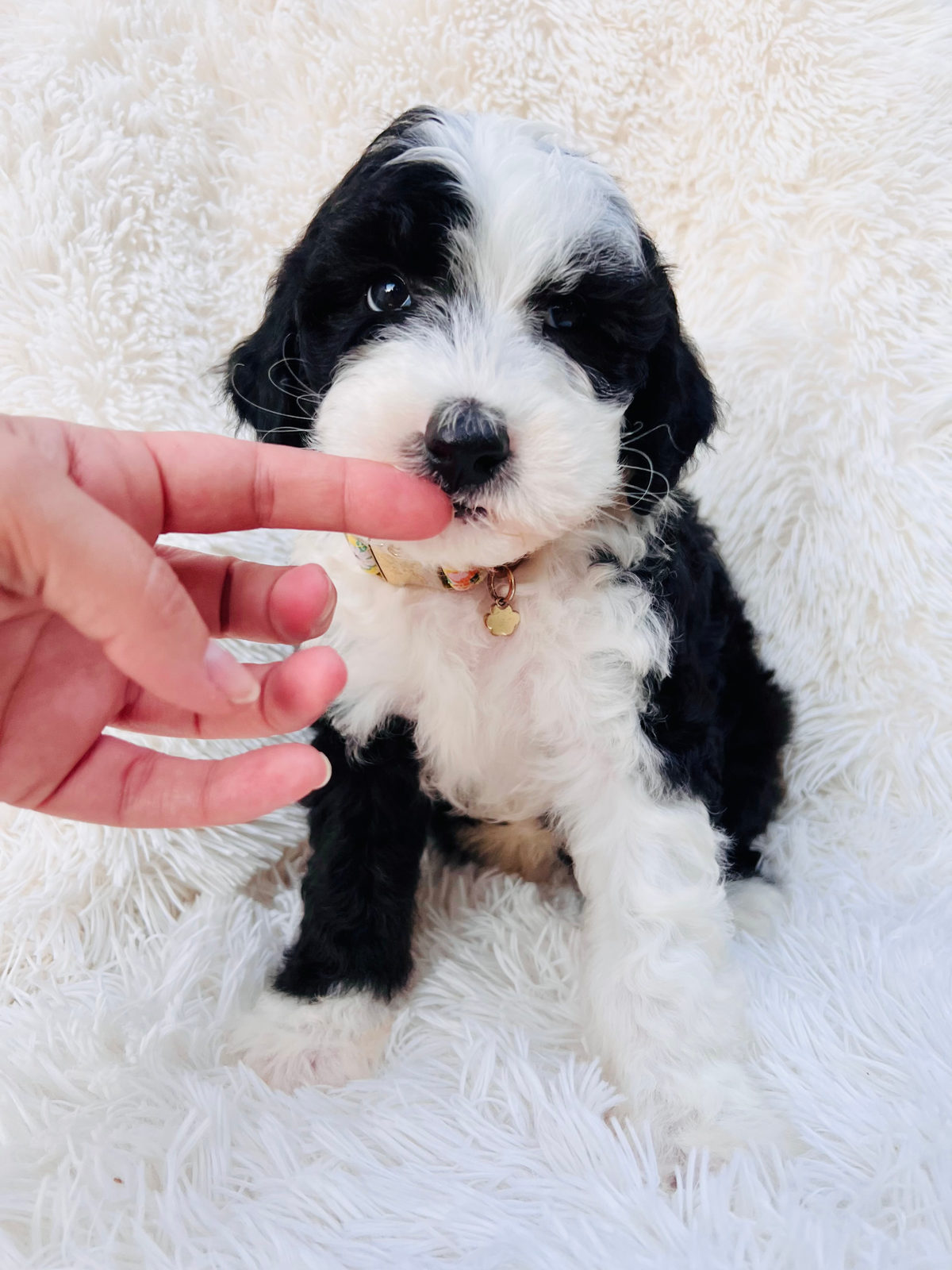
    Family raised sheepadoodle puppy socialized before going home

    Puppies are raised in our home and socialized from birth, not in a kennel or barn setting.

    Preparing Your Home Before Puppy Day

    While you’re waiting for your puppy’s homecoming, it’s worth using the time to get your household ready. A few things that make the first weeks smoother:

    • Puppy-proof your space. Secure loose cords, small objects, and anything chewable at puppy height.
    • Set up a crate and a designated potty area. Consistency from day one speeds up house training.
    • Line up a veterinarian. Schedule an initial wellness visit within the first week or two of bringing your puppy home.
    • Plan your first few days off. If you can arrange time away from work for the first several days, the adjustment period tends to go more smoothly for both of you.
    • Stock up on essentials. Age-appropriate food, a properly fitted collar or harness, and basic grooming tools will save a last-minute scramble.

    None of this needs to be complicated, but a little preparation goes a long way toward a calm transition for a puppy leaving its littermates for the first time.

    Considering an Older Puppy or Adult Instead?

    We occasionally have older puppies and young adults looking for their forever home. If a young puppy’s timeline doesn’t work for your household, or you’d simply prefer a dog closer to its adult size and temperament, visit our available adults page to see who’s currently available.

    Sheepadoodle puppy exploring new home after adoption

    A little preparation before puppy day helps the whole household settle in faster.

    Good Questions to Ask Any Breeder

    Whether you’re talking to us or another breeder, a responsible one should welcome direct questions. Here are the ones worth asking before you commit to any puppy:

    Questions to ask a breeder before reserving a puppy
    QuestionWhy It Matters
    How is the puppy raised day to day?Family-raised, socialized puppies typically adjust to home life faster
    What health testing was done on the parents?Reduces risk of inherited health conditions
    Can I see the puppy’s living environment?Transparency is one of the clearest signs of a responsible breeder
    What’s included when the puppy goes home?Vaccination records, microchip info, and care guidance should be standard
    How does the reservation process work?Clear communication upfront avoids confusion later
    Are older puppies or adults ever available?Useful to know if your timeline doesn’t match a current litter

    According to the ASPCA, a responsible breeder should be transparent, willing to answer questions, and open about where and how puppies are raised. If a breeder is reluctant to share that information, it’s a reason to keep looking.

    It’s worth applying the same standard everywhere you look, including with us. If you’d like to talk through our program, our current litter, or general questions about the breed before deciding anything, that conversation costs nothing and we’d genuinely rather you feel confident than rushed.

    Sheepadoodle puppy with vaccination and microchip records ready for new home

    Ask any breeder what documentation comes with your puppy on pickup day.

    Sheepadoodle puppy ready to meet new family after reservation process

    Every conversation starts the same simple way — a call, an email, and no pressure to decide before you’re ready.

    Ready to Start the Conversation?

    Call, email, or use our contact form to request an application. We’re happy to answer questions about a current litter or upcoming availability.

    Contact Sunshine Sheepadoodles

    Frequently Asked Questions

    How do I start the process of reserving a puppy?

    Call or email us to request an application. We’re happy to answer any questions along the way as you decide if the timing and litter are right for your family.

    How often do you have litters available?

    We keep our program small and intentional, with only two litters a year, so availability varies. Check our available puppies page for the current litter.

    Are Sunshine Sheepadoodles puppies vaccinated before going home?

    Yes, all of our puppies are vaccinated and microchipped before they go home, and they are litter trained, crate trained, and potty trained.

    What if I’d prefer an older puppy or adult dog?

    We occasionally have older puppies and young adults looking for their forever home. Visit our available adults page to see who’s currently available.

    Not sure which size or coat color is the right fit first? Start with our Sheepadoodle size guide and coat colors and patterns guide, then reach out whenever you’re ready.

  • Sheepadoodle vs. Goldendoodle: Which Is Right for Your Family?

    Sheepadoodle vs. Goldendoodle: Which Is Right for Your Family?

    Sheepadoodle Guide · Sunshine Sheepadoodles

    Sheepadoodle puppy compared to Goldendoodle breed

    Sheepadoodles and Goldendoodles are two of the most popular Poodle-mix breeds, and it’s easy to see why people cross paths between the two while researching. Both are shaggy, affectionate, low-shedding family dogs — but the parent breed behind each one shapes some real differences worth knowing before you decide.

    If you’ve narrowed your search down to these two, you’re already asking the right question. The short version: both breeds share more similarities than differences, and the choice usually comes down to a handful of specific factors covered below rather than one breed being universally “better.”

    Sheepadoodle vs. Goldendoodle: At a Glance

    Sheepadoodle vs. Goldendoodle comparison
    CategorySheepadoodleGoldendoodle
    Non-Poodle ParentOld English SheepdogGolden Retriever
    Typical CoatWavy to shaggy, black & white commonWavy to curly, gold/apricot common
    Standard Size (adult)55–85+ lbs50–90 lbs
    Mini Size (adult)25–45 lbs15–35 lbs
    Energy LevelHigh, often described as slightly calmer as adultsHigh, sustained playful energy
    TemperamentLoyal, protective, people-focusedSociable, outgoing, eager to please
    TrainabilityHighHigh
    SheddingLow (varies by generation)Low (varies by generation)
    Grooming FrequencyEvery 6–8 weeksEvery 6–8 weeks

    Appearance & Coat

    The clearest visual difference comes from the non-Poodle parent. A Sheepadoodle’s Old English Sheepdog side tends to produce a shaggier, more “sheepdog” look, most commonly in black and white. A Goldendoodle’s Golden Retriever side leans toward the classic gold, apricot, or cream “teddy bear” coloring most people associate with the breed.

    Goldendoodle dog with curly apricot coat, comparison breed to sheepadoodle

    Goldendoodles typically carry the gold or apricot coloring inherited from their Golden Retriever parent.

    Temperament & Energy Level

    Both breeds are affectionate and people-oriented, but the emphasis differs slightly. Sheepadoodles tend to be more protective and watchful, a trait from the Old English Sheepdog’s herding and guarding background. Goldendoodles tend to be more universally friendly and outgoing, reflecting the Golden Retriever’s famously easygoing nature.

    Neither breed is aggressive by nature, and both need daily exercise and mental stimulation. If you want a dog that’s a little more reserved with strangers but deeply bonded to its family, a Sheepadoodle often fits that description slightly better. If you want a dog that greets every person and dog like a long-lost friend, a Goldendoodle often leans that direction.

    Sheepadoodle puppy showing protective and affectionate temperament

    Sheepadoodles tend to be slightly more watchful and protective than the typically outgoing Goldendoodle.

    Size & Growth

    Both breeds come in mini and standard sizes, driven by which size Poodle was used in the cross, and the ranges overlap quite a bit. Standard Sheepadoodles run slightly heavier on average than standard Goldendoodles, while mini Goldendoodles can run a bit smaller than mini Sheepadoodles. Neither difference is large enough to be a deciding factor on its own — ask any specific breeder about their line’s typical adult size.

    Growth timelines are also similar: both breeds reach adult height somewhere around 9 to 12 months for mini sizes, and 16 to 18 months for standard sizes, with the final year mostly spent filling out muscle and coat rather than growing taller. If precise adult size matters to your household, our Sheepadoodle size guide breaks this down in more detail by size class.

    Grooming & Shedding

    Both breeds are low-shedding compared to their non-Poodle parent, and both need comparable grooming commitments: brushing several times a week and professional grooming roughly every 6 to 8 weeks. Neither breed is truly hypoallergenic (no dog is), but both are commonly chosen by people managing mild to moderate dog allergies. Our Sheepadoodle hypoallergenic guide covers how coat generation affects shedding in more detail.

    Goldendoodle dog outdoors showing curly low-shedding coat

    Grooming needs are broadly similar between the two breeds, regardless of coat color.

    Health Considerations

    As crossbreeds, both Sheepadoodles and Goldendoodles generally benefit from hybrid vigor compared to some purebred lines, but neither is immune to health issues carried by their parent breeds. Goldendoodles can inherit conditions associated with Golden Retrievers, including certain eye and joint conditions. Sheepadoodles can inherit conditions associated with Old English Sheepdogs, including hip dysplasia.

    Whichever breed you’re considering, ask the breeder directly what health testing was done on both parents — that matters more than the breed name itself. Reputable breeders of either mix should be able to share hip, elbow, and eye clearances for the parent dogs without hesitation.

    Healthy adult sheepadoodle dog from health-tested parents

    Asking about parent health testing matters more than the breed name, regardless of which doodle you choose.

    Which One Fits Your Lifestyle?

    Consider a Sheepadoodle If

    • You want a dog that’s deeply bonded and a bit protective of the family
    • You like the classic shaggy sheepdog look
    • You don’t mind a slightly more independent streak occasionally

    Consider a Goldendoodle If

    • You want a dog that’s outgoing with everyone it meets
    • You prefer the classic gold/apricot “teddy bear” look
    • You want a breed with an especially long track record of family-friendliness

    According to the Goldendoodle Association of North America, a well-bred Goldendoodle should be friendly, trustworthy, and stable in temperament — a standard that maps closely onto what responsible Sheepadoodle breeders aim for as well. In practice, the biggest difference between the two often comes down to personal preference on looks and slight temperament tendencies, not one being objectively “better” than the other.

    Adult sheepadoodle dog showing family-friendly temperament

    Whichever breed you choose, temperament and health testing matter more than coat color alone.

    Meet a Sheepadoodle in Person

    The best way to know which breed fits your family is to spend time with one. See our current litters and reach out with questions.

    View Available Puppies

    Frequently Asked Questions

    Which is calmer, a Sheepadoodle or a Goldendoodle?

    Sheepadoodles are sometimes described as slightly calmer once they reach adulthood, though both breeds are high-energy through puppyhood and adolescence. Individual temperament varies more than breed generalizations suggest.

    Do Sheepadoodles or Goldendoodles shed less?

    Shedding in both breeds depends more on generation (F1 vs. F1B) and coat type than on which breed you choose. Neither is guaranteed to be lower-shedding than the other across the board.

    Are Sheepadoodles bigger than Goldendoodles?

    Standard Sheepadoodles tend to run slightly heavier on average than standard Goldendoodles, though both breeds have overlapping size ranges depending on the specific Poodle parent used.

    Which breed is easier to train?

    Both breeds are highly trainable thanks to their Poodle genetics. Goldendoodles are often described as slightly more eager-to-please, while Sheepadoodles can show more independence, though this varies by individual dog.

    Curious how Sheepadoodle sizing compares across categories? See our Sheepadoodle size guide, or learn more about Sheepadoodle temperament in depth.

  • Sheepadoodle Coat Colors & Patterns: The Complete Guide

    Sheepadoodle Coat Colors & Patterns: The Complete Guide

    Sheepadoodle Guide · Sunshine Sheepadoodles

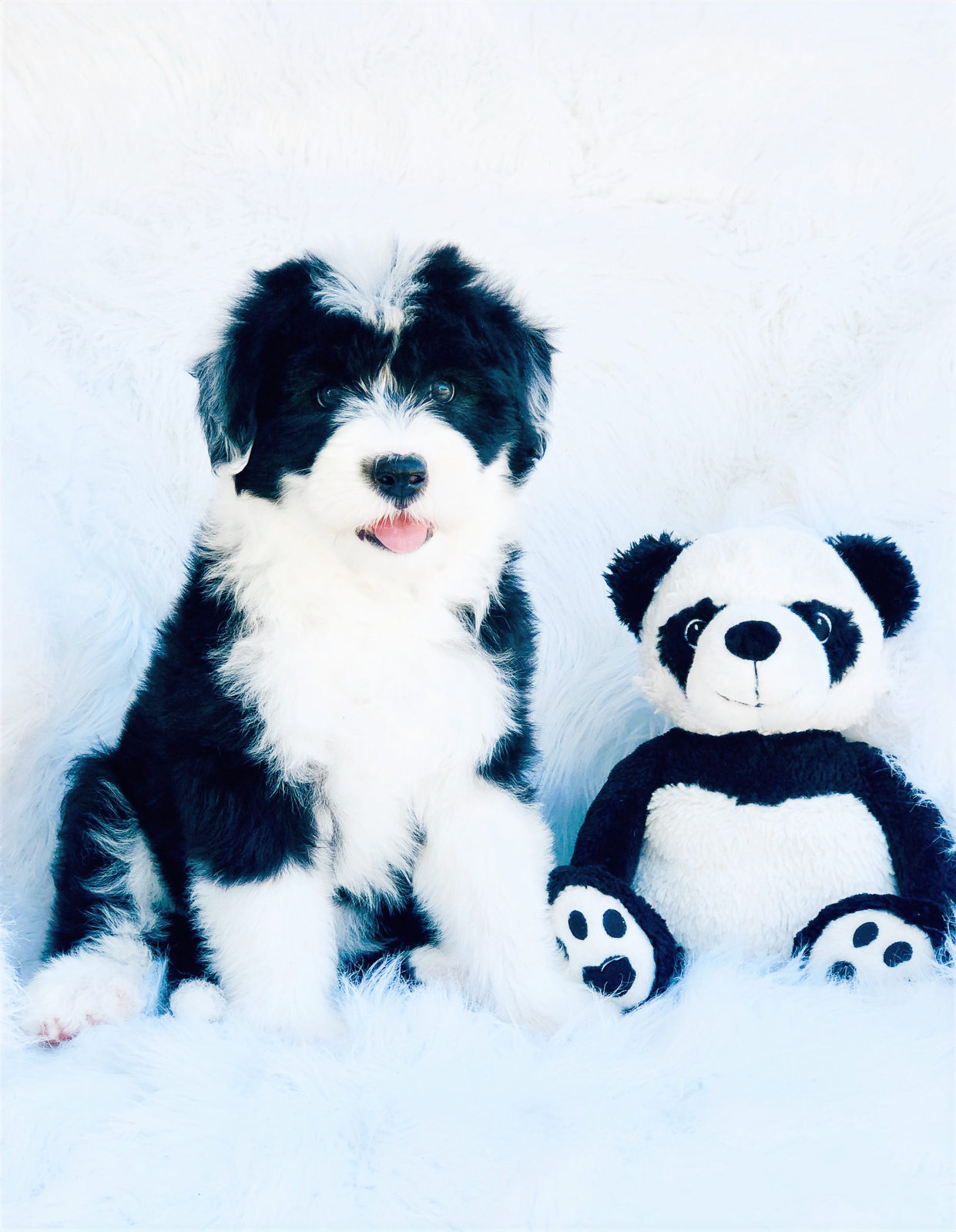
    Black and white sheepadoodle puppy showing classic tuxedo coat pattern

    Sheepadoodle coats come in a wider range than most people expect. Between base colors, patterns, and the way puppy coats change as they mature, it’s easy to see a photo online and wonder whether what you’re looking at is common, rare, or something to ask more questions about. Here’s a clear breakdown.

    Common Sheepadoodle Coat Colors

    Sheepadoodle coat colors and how common they are
    ColorDescriptionCommonality
    Black & WhiteBold, symmetrical black patches over a white base, closest to the classic Old English Sheepdog lookMost common
    White / CreamLittle to no dark patching, sometimes with light tan shading around the ears or faceCommon
    Brown / ChocolateSolid or patched deep brown coat, sometimes lightening with ageLess common
    Silver / GrayLighter gray-toned coat, often a black puppy that has “cleared” (faded) with ageLess common
    MerleMarbled patches of color on a lighter base, often paired with blue or heterochromatic eyesRare
    Solid white and cream sheepadoodle puppy coat color

    Solid white and cream coats are common, especially in litters with a strong Poodle influence.

    Coat Patterns Explained

    Beyond base color, Sheepadoodles can carry a few distinct patterns:

    • Parti: At least 50% white coat with large patches of another color.
    • Tuxedo: A solid-colored body with a white chest, chin, and paws — the “classic” Sheepadoodle look.
    • Abstract: Small, scattered patches of white on an otherwise solid-colored body.
    • Merle: A mottled, marbled pattern caused by a specific gene, covered in more detail below.

    These patterns aren’t exclusive to one base color — a tuxedo pattern can appear on a black, brown, or silver dog, and the same goes for parti and abstract markings. When you’re comparing puppies from the same litter, you’ll often see several different patterns show up even though every puppy shares the same two parents.

    Brown & Chocolate Sheepadoodles

    Brown-coated Sheepadoodles tend to be less common than black and white, since the coloring depends on both parents carrying the right combination of genes. Puppies born a deep chocolate brown sometimes lighten noticeably as their adult coat comes in.

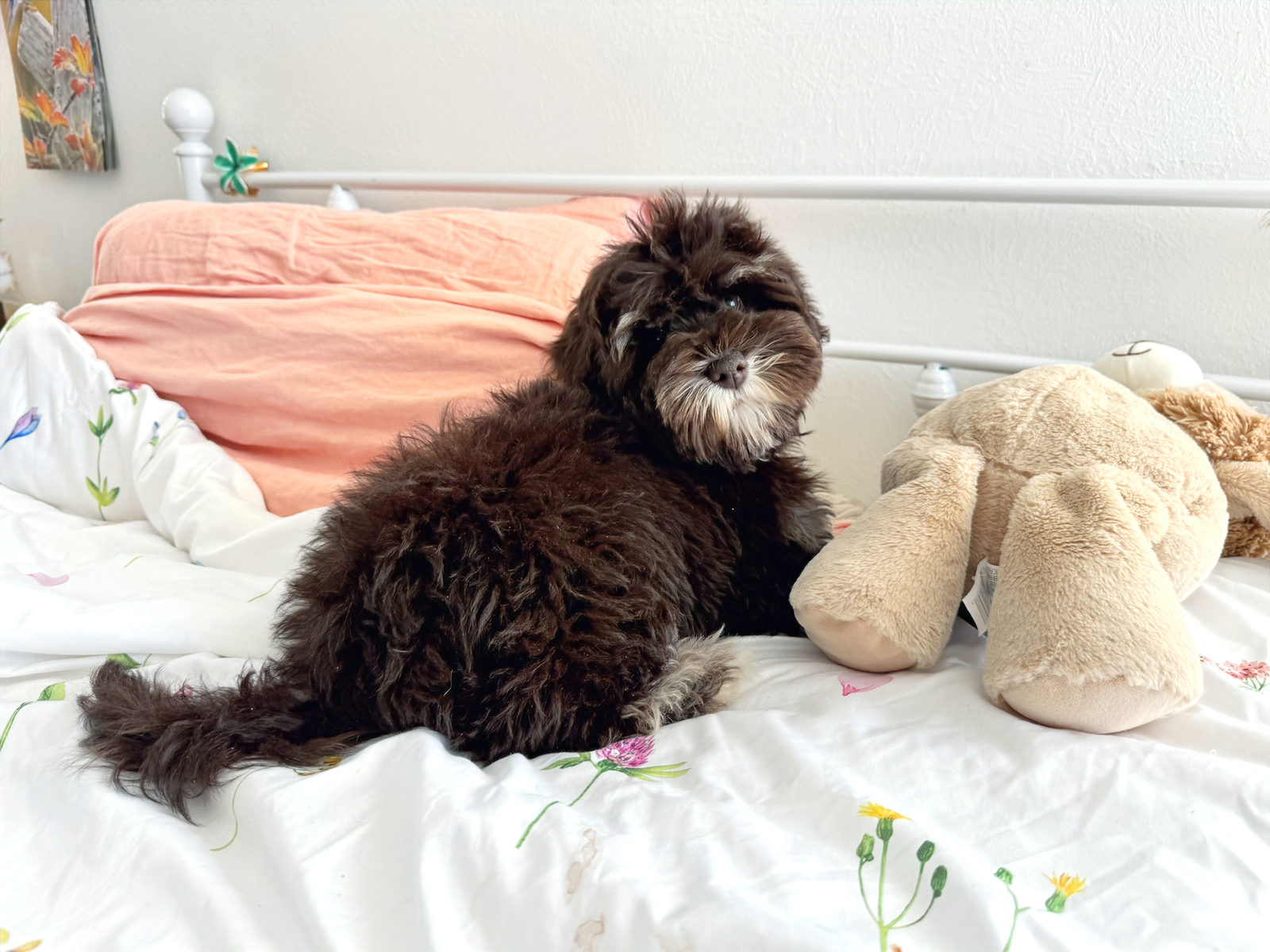
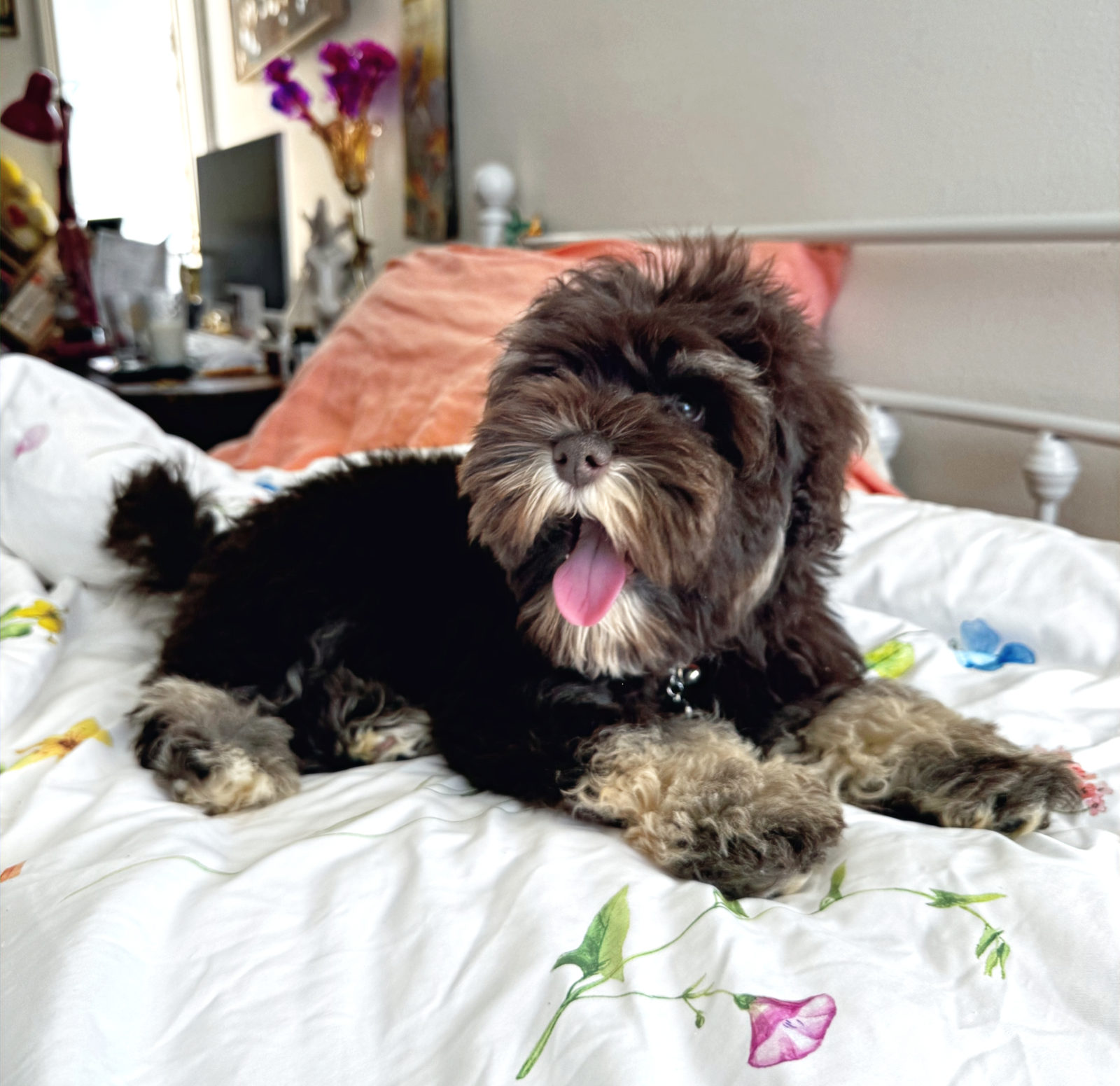
    Dark chocolate brown sheepadoodle puppy coat color

    Chocolate-coated Sheepadoodles are one of the less common color variations.

    Do Sheepadoodle Colors Change As They Grow?

    Often, yes. Many Sheepadoodle puppies inherit a “clearing” or “fading” gene from their Poodle side, which lightens the coat over the first one to two years. A puppy born jet black can mature into a silver or gray adult, and a dark brown puppy can lighten to a caramel or tan tone.

    If a specific adult color matters to you, ask your breeder whether the parents’ coats changed color as they matured — that history is a far better predictor than the puppy’s coat at eight weeks old.

    Dark brown sheepadoodle puppy coat that may lighten with age

    A puppy’s coat color at eight weeks isn’t always a reliable predictor of its adult color.

    Blue Eyes in Sheepadoodles

    Blue or partially blue eyes show up in some Sheepadoodles, most often (but not exclusively) alongside merle patterning or heavily white coats. Blue eyes alone aren’t inherently a health concern, but when they occur alongside the merle gene specifically, they’re worth understanding in the context below.

    Adult sheepadoodle dog with blue eyes and white coat

    Blue eyes can occur in Sheepadoodles independent of coat color or pattern.

    What About Merle Sheepadoodles?

    Merle is a genetic pattern, not just a color — it creates marbled patches of darker pigment on a lighter base coat, often paired with blue or partially blue eyes. It’s genuinely rare in Sheepadoodles, since the merle gene isn’t common in Poodles and only occasionally appears in Old English Sheepdog lines.

    Merle is also where responsible breeding matters most. According to the UC Davis Veterinary Genetics Laboratory, dogs that inherit two copies of the merle gene (a “double merle”) are at significantly higher risk of congenital deafness and vision problems, because the gene affects pigment development in the structures responsible for hearing and sight.

    Signs of Responsible Merle Breeding

    • Breeder never pairs two merle-carrying parents together
    • DNA merle testing available on request
    • BAER hearing test results for merle puppies
    • Ophthalmic exam results available

    Red Flags to Avoid

    • No willingness to share genetic testing results
    • Breeding merle-to-merle to “guarantee” merle puppies
    • Marketing merle color without disclosing health testing
    • Pressure to decide quickly on a merle puppy

    If a merle puppy is what you’re after, asking direct questions about parent testing isn’t rude — it’s exactly what a responsible breeder expects and welcomes.

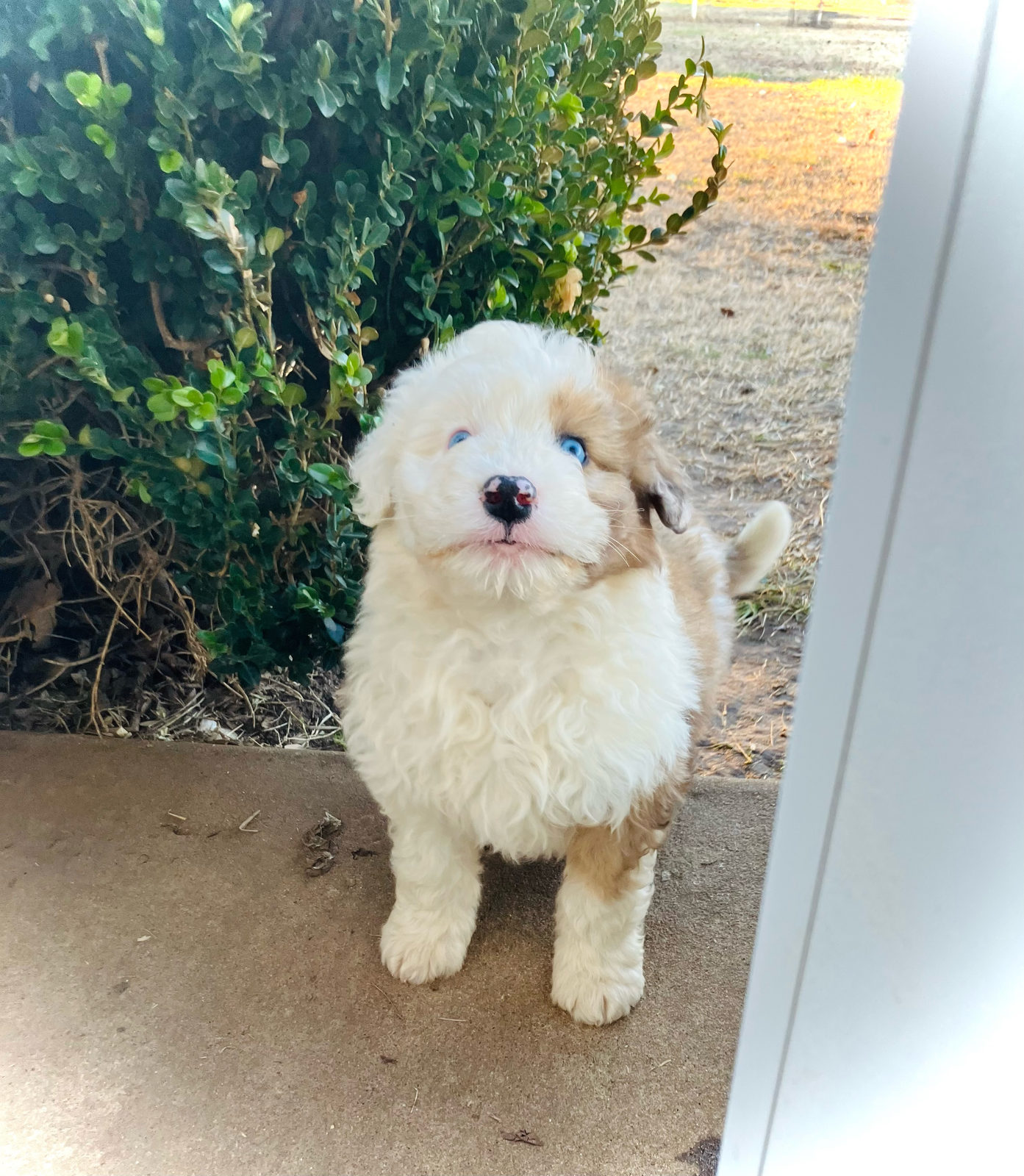
    Sheepadoodle puppy with blue eyes and brown and white coat markings

    Coat markings and eye color vary widely between individual puppies, even within the same litter.

    Choosing a Color Responsibly

    It’s natural to have a color preference — plenty of buyers fall in love with a specific look before anything else. A few things worth keeping in mind as you shop:

    • Color shouldn’t come before health testing. A striking coat is never a substitute for genetic screening, especially with merle.
    • Rare colors often carry a premium price. That’s fine as a market reality, but it’s not itself evidence of quality or health.
    • Ask to see the parents, not just the puppy. Parent coat and eye color is the best predictor of what a puppy will mature into.
    • Stay flexible if you can. The healthiest, best-fit puppy in a litter isn’t always the one with the rarest coat.

    Ask About Coat Color for a Specific Litter

    Coat outcomes vary by pairing. Reach out and we can talk through what a current or upcoming litter is expected to produce.

    Contact Sunshine Sheepadoodles

    Frequently Asked Questions

    What is the rarest Sheepadoodle color?

    Merle is generally considered the rarest Sheepadoodle coat pattern, since the gene is uncommon in both parent breeds. True chocolate/brown coats are also less common than black and white.

    Is it safe to breed two merle Sheepadoodles together?

    No. Breeding two merle dogs together statistically produces “double merle” offspring at a higher rate, which carries a significantly increased risk of deafness and vision problems. Responsible breeders never pair two merle dogs together.

    Will my Sheepadoodle puppy’s coat color change?

    Possibly. Many Sheepadoodles inherit a coat-clearing gene from their Poodle side that can lighten their color noticeably within the first one to two years.

    Do blue eyes mean a Sheepadoodle is merle?

    Not necessarily. Blue eyes can occur in Sheepadoodles independent of the merle gene, though the two do often appear together.

    Coat color is just one part of the picture — see our Sheepadoodle size guide and temperament guide for the rest. Ready to see what’s currently available? Visit our available puppies page.

  • Sheepadoodle Temperament: What to Expect from This Family-Friendly Breed

    Sheepadoodle Temperament: What to Expect from This Family-Friendly Breed

    Sheepadoodle Guide · Sunshine Sheepadoodles

    Sheepadoodle family dog showing affectionate temperament with owner

    A dog’s temperament matters more day-to-day than its coat color or size. If you’re weighing whether a Sheepadoodle fits your household, here’s a grounded look at what this breed is actually like to live with — the good, and the parts that catch first-time owners off guard.

    Where Sheepadoodle Temperament Comes From

    A Sheepadoodle’s personality is a blend of its two parent breeds. The Old English Sheepdog contributes loyalty, a herding instinct, and a naturally protective streak toward family. The Poodle contributes sharp intelligence, trainability, and a more people-focused, eager-to-please attitude.

    According to PetMD, Sheepadoodles are known for being affectionate, loyal, and highly attuned to their owners’ moods — a trait that shows up early, often by the time a puppy is a few months old.

    Key Personality Traits

    Sheepadoodle temperament traits and where they come from
    TraitWhat It Looks LikePrimarily Inherited From
    AffectionateSeeks physical closeness, leans in for pets, follows family room to roomBoth parent breeds
    IntelligentLearns commands quickly, can get bored without mental challengePoodle
    ProtectiveAlert to strangers, watchful over children in the householdOld English Sheepdog
    SocialFriendly with new people and other dogs when well-socializedBoth parent breeds
    Herding instinctMay nip heels, circle, or try to “gather” kids or other petsOld English Sheepdog
    People-orientedDoesn’t do well left alone for long stretchesBoth parent breeds
    Sheepadoodle puppy playing showing intelligent and social temperament

    Sheepadoodles inherit trainability and eagerness to please largely from their Poodle lineage.

    Are Sheepadoodles Good with Kids?

    Generally, yes — with the usual caveats that apply to any dog around children. Well-socialized Sheepadoodles tend to be patient and gentle, and their herding instinct often shows up as a protective, watchful attitude toward younger family members rather than aggression.

    That said, this is a genuinely active breed. Families looking for a low-energy dog to lounge around toddlers may find a Sheepadoodle’s enthusiasm a bit much without enough daily outlet for that energy. Supervised introductions and early socialization make a real difference regardless of age.

    Sheepadoodle dog with family showing gentle temperament around children

    Well-socialized Sheepadoodles are typically patient and protective around children in the household.

    Early Socialization Matters

    Like most intelligent, people-focused breeds, Sheepadoodles benefit enormously from early exposure to new people, places, sounds, and other animals during the first several months of life. Puppy socialization classes, controlled introductions to kids of different ages, and regular exposure to everyday household chaos all help shape a well-adjusted adult dog.

    Breeders who start this exposure before puppies go home give new owners a real head start — ask what a breeder does for early socialization before eight weeks, since that window matters more than most people realize.

    Energy Level & Exercise Needs

    Sheepadoodles are not a low-energy breed. Most need real daily exercise, not just a walk around the block, and their exercise needs shift as they grow:

    Sheepadoodle exercise needs by life stage
    Life StageDaily ExerciseNotes
    Puppy (8–16 weeks)Short, frequent play sessionsAvoid over-exercising growing joints; follow the 5-minutes-per-month-of-age guideline
    Adolescent (6mo–2yrs)60+ minutesPeak energy and testing-boundaries phase; mental stimulation matters as much as physical
    Adult45–90 minutesVaries by size class; standards generally need more than minis
    Senior30–45 minutesLower-impact activity, adjusted to joint health

    Training & Intelligence

    Both parent breeds are highly trainable, and Sheepadoodles generally pick up commands, house training, and basic manners quickly with consistency. Positive reinforcement methods work well with this breed’s people-pleasing streak.

    Where things get trickier is the independent streak some Sheepadoodles inherit from the Old English Sheepdog side. It doesn’t show up in every dog, but if it does, patience and consistency matter more than repetition alone.

    Crate training, basic obedience, and puppy classes in the first six months tend to pay off well with this breed. Because Sheepadoodles are food- and praise-motivated, positive reinforcement almost always outperforms correction-based methods — and it tends to strengthen the bond you’re already building with a naturally affectionate dog.

    Sheepadoodle puppy during training session showing eager to please temperament

    Consistent, positive-reinforcement training tends to work best with this breed’s people-pleasing temperament.

    Common Behavior Challenges to Watch For

    What Comes Naturally

    • Bonding closely with the whole family
    • Reading human emotions and responding to them
    • Getting along with other pets when introduced properly
    • Picking up new commands and routines quickly

    What to Actively Manage

    • Herding nips or chasing during play, especially with kids
    • Separation anxiety if left alone too long, too often
    • Boredom-driven mischief without enough mental stimulation
    • Jumping or over-excitement when greeting new people

    Is a Sheepadoodle Right for Your Household?

    • You’re home often, or can arrange regular company: This breed doesn’t thrive on being left alone for long, unpredictable stretches.
    • You can commit to daily exercise: Even mini Sheepadoodles need consistent physical and mental engagement.
    • You have time for training in the first year: The payoff for early consistency is a well-mannered adult dog.
    • You want a genuinely affectionate, in-your-space companion: If you want a more independent, aloof dog, this probably isn’t the right breed.
    Adult sheepadoodle dog relaxing at home showing calm adult temperament

    Adult Sheepadoodles often settle into a calmer, still-affectionate rhythm once past the high-energy adolescent phase.

    Meet the Personality Behind a Specific Litter

    Every litter has its own energy and temperament tendencies based on the parents. Reach out and we’re happy to talk through what to expect.

    Contact Sunshine Sheepadoodles

    Frequently Asked Questions

    Do Sheepadoodles bark a lot?

    Sheepadoodles can be alert barkers, especially in response to strangers or unfamiliar noises, thanks to their Old English Sheepdog watchdog instincts. Consistent training can help manage excessive barking.

    Can Sheepadoodles be left alone during the workday?

    Sheepadoodles are people-oriented and generally don’t do well with long stretches of daily isolation. If you work full-time away from home, plan for a midday break, dog walker, or daycare, especially during puppyhood.

    Are Sheepadoodles aggressive?

    No, Sheepadoodles are not typically an aggressive breed. What can look like aggression — nipping or chasing during play — is usually herding instinct from the Old English Sheepdog side, which training can redirect.

    How does temperament differ between mini and standard Sheepadoodles?

    Temperament is driven more by individual genetics and upbringing than size class. That said, standard Sheepadoodles are sometimes described as slightly calmer as adults, while minis can retain puppy-like energy a bit longer.

    Curious how temperament connects to size and coat type? Check out our Sheepadoodle size guide and our guide on Sheepadoodle shedding and allergies. When you’re ready to meet a puppy in person, our available puppies page is the best place to start.

  • Are Sheepadoodles Hypoallergenic? What Allergy Sufferers Should Know

    Are Sheepadoodles Hypoallergenic? What Allergy Sufferers Should Know

    Sheepadoodle Guide · Sunshine Sheepadoodles

    Sheepadoodle puppy with soft wavy coat from Sunshine Sheepadoodles Texas

    If allergies are part of your decision-making process, “hypoallergenic” is probably the first word you searched. It’s also one of the most misunderstood words in the dog world. Here’s an honest breakdown of what actually makes a Sheepadoodle allergy-friendlier than some breeds — and what it can’t promise.

    Is Any Dog Truly Hypoallergenic?

    No. According to the American College of Allergy, Asthma and Immunology, there is no such thing as a completely non-allergenic dog breed. People react to proteins found in a dog’s dander, saliva, and urine — not just loose hair — so even a dog that barely sheds can still trigger a reaction in a sensitive person.

    What “hypoallergenic” really means in practice is lower-shedding, which reduces how much dander gets carried around on loose fur and distributed through your home. That’s a meaningful difference for a lot of allergy sufferers, just not an absolute guarantee.

    Why Sheepadoodles Are Considered Allergy-Friendlier

    A Sheepadoodle is a cross between an Old English Sheepdog and a Poodle. The Old English Sheepdog side sheds normally, like most double-coated breeds. The Poodle side is where the low-shedding, curlier coat comes from.

    Sheepadoodle puppy inheriting low-shedding Poodle coat genetics

    The Poodle side of a Sheepadoodle’s ancestry is what drives its lower-shedding coat.

    How much of that Poodle coat a given puppy inherits depends on genetics — and that’s where “generation” comes in. According to VCA Animal Hospitals, breeds marketed as hypoallergenic tend to produce less airborne dander simply because they shed less hair to carry it — not because the dander itself is different.

    Sheepadoodle puppy showing curly Poodle-influenced coat texture

    Coat curl and texture — more than color or size — is what determines how much a Sheepadoodle sheds.

    F1 vs. F1B Sheepadoodles: Which Sheds Less?

    An F1 Sheepadoodle is a first-generation cross — roughly half Old English Sheepdog, half Poodle. An F1B Sheepadoodle is an F1 bred back to a Poodle, making it about 75% Poodle. That extra Poodle percentage is the difference that matters most for allergy sufferers.

    F1 vs. F1B Sheepadoodle: coat, shedding, and allergy comparison
    GenerationApprox. Poodle %Typical CoatShedding LevelBest For
    F1~50%Wavy to flat, varies by litterLow to moderateMild allergy sufferers
    F1B~75%Wavy to curly, more consistentVery lowModerate to severe allergy sufferers
    F1BB~87.5%Curly, Poodle-likeMinimalSevere allergy sufferers
    MultigenVaries, often bred for consistencyCurly, stabilized across littersLow to minimalBuyers wanting predictable coat outcomes

    Within a single F1 litter, coat type can actually vary quite a bit — some puppies come out wavier, some flatter, some curlier — because that generation carries the widest genetic mix. F1B and later generations tend to be more consistent since they lean more heavily toward the Poodle side.

    Adult sheepadoodle with low-shedding curly coat texture

    F1B and multigenerational Sheepadoodles carry a higher percentage of Poodle genetics, generally meaning less shedding.

    Coat Type Matters More Than Labels Alone

    Don’t rely on the F1/F1B label by itself. Two puppies from the same litter can still have noticeably different coats. If allergies are a serious concern, ask your breeder:

    • What coat type did this specific puppy’s parents produce in past litters?
    • Can you spend time with an adult dog from a similar pairing before committing?
    • How often will this coat type need professional grooming?

    As a general rule, curlier, denser coats shed less but require more frequent brushing and professional grooming (every 4–6 weeks) to prevent matting. Looser, wavier coats shed a bit more but are typically lower-maintenance day to day.

    Living with a Sheepadoodle If You Have Allergies

    Whether your Sheepadoodle is F1 or F1B, a few habits make a real difference in allergen exposure at home:

    Helps Reduce Allergens

    • Brushing 2–3x per week (outdoors if possible)
    • Bathing on a regular schedule your groomer recommends
    • HEPA air purifiers in bedrooms
    • Keeping the dog off upholstered furniture and out of the bedroom
    • Washing hands after petting, before touching your face

    Can Make Allergies Worse

    • Skipping regular grooming appointments
    • Carpeted floors that trap dander
    • Letting the coat mat (traps more dander and debris)
    • Infrequent vacuuming/laundering of dog bedding

    If you’re in Texas, it’s worth noting that cedar fever and ragweed season can compound pet-related symptoms in late winter and fall. If you already deal with seasonal allergies here, talk to your doctor about how pet dander exposure might layer on top before bringing a puppy home.

    Groomed adult sheepadoodle dog with well-maintained low-shedding coat

    Regular grooming keeps a Sheepadoodle’s coat from matting and reduces how much dander accumulates around your home.

    Test Your Reaction Before You Commit

    Because individual reactions vary so much, the single best way to know how you’ll do with a specific dog is to spend real time with one before bringing a puppy home. A few practical ways to do that:

    1. Visit in person. Spend an hour or more with an adult dog from a similar pairing, ideally in an indoor space, before making a decision.
    2. Talk to your allergist. Some allergists can run a skin or blood test for dog dander sensitivity, which can help set expectations before you commit.
    3. Ask about the specific parents. A breeder who has produced multiple litters from the same pairing can tell you what coat type and shedding level to realistically expect.
    4. Start with short visits. If you can, arrange a few short visits over time rather than a single long one, since some reactions build with repeated or prolonged exposure.
    Family spending time with sheepadoodle puppy before adoption

    Spending time with a dog from a similar pairing before committing is the most reliable way to gauge your personal reaction.

    Have Allergy Questions About a Specific Litter?

    Coat type varies puppy to puppy. Reach out and we can talk through what a specific litter’s parents have historically produced.

    Contact Sunshine Sheepadoodles

    Frequently Asked Questions

    Are F1B Sheepadoodles completely non-shedding?

    Not completely, but close. F1B Sheepadoodles, with roughly 75% Poodle genetics, shed very little compared to F1s or purebred Old English Sheepdogs. Some minimal shedding is still normal for any dog.

    Can someone with severe dog allergies safely own a Sheepadoodle?

    It depends on the severity of the allergy and the specific dog’s coat. According to allergy specialists, no dog is guaranteed safe for severe allergy sufferers. Spending time with an adult dog from a similar pairing before committing is the most reliable way to gauge your personal reaction.

    Does shaving a Sheepadoodle’s coat reduce allergens?

    Not significantly. Allergens come primarily from dander (skin cells) and saliva, not just hair length, so shaving doesn’t meaningfully reduce allergen exposure and can affect coat health.

    How often should an allergy sufferer bathe their Sheepadoodle?

    Follow your groomer’s or veterinarian’s specific recommendation for your dog’s coat type, since over-bathing can dry out skin and actually increase dander production.

    Curious how coat type connects to overall size and grooming needs? Our Sheepadoodle size guide covers how coat and build vary across micro, mini, and standard sizes, and our available puppies page lists current litters if you’re ready to start a conversation about a specific coat type.

  • Sheepadoodle Size Guide: Mini, Micro, Toy & Standard Sizes Explained

    Sheepadoodle Size Guide: Mini, Micro, Toy & Standard Sizes Explained

    Sheepadoodle Guide · Sunshine Sheepadoodles

    Mini sheepadoodle puppy from Sunshine Sheepadoodles used to illustrate sheepadoodle size guide

    If you’ve started researching this breed, you’ve probably noticed that “sheepadoodle” isn’t just one size. Between micro, mini, medium, and standard sheepadoodles, the same breed name can describe anything from an 18-pound lap dog to an 85-pound shadow that follows you room to room.

    That range trips up a lot of first-time buyers. This guide breaks down exactly what separates each size class, how big your puppy will realistically get, and which size tends to fit best with different households — including a few things worth thinking about if you live somewhere with a hot Texas summer.

    Sheepadoodle Size Categories at a Glance

    A sheepadoodle’s adult size comes down almost entirely to which size of Poodle was used in the cross. Breeders typically work with four recognized size classes:

    Sheepadoodle size classes: height, weight, and Poodle parentage
    Size ClassHeight (at shoulder)Adult WeightPoodle Parent Used
    Micro / Toy10–14 in10–25 lbsToy Poodle
    Mini15–20 in25–45 lbsMiniature Poodle
    Medium (Moyen)16–22 in35–55 lbsMoyen or small Standard Poodle
    Standard20–27 in55–85+ lbsStandard Poodle

    Because the sheepadoodle isn’t recognized as an official breed by the American Kennel Club, there’s no single governing standard the way there is for, say, an Old English Sheepdog. That means sizing within each class is a range, not a guarantee — genetics, generation (F1, F1b, multigen), and the individual Poodle parent’s size all play a role.

    Micro sheepadoodle puppy showing smallest sheepadoodle size class

    Micro sheepadoodles are the smallest size class, bred using a Toy Poodle parent.

    Micro Sheepadoodle

    The micro sheepadoodle (sometimes marketed as “toy”) is the smallest of the group, typically landing between 10 and 25 pounds full grown. This size is created by crossing an Old English Sheepdog with a Toy or Tiny Poodle, often over more than one generation to stabilize the smaller frame.

    Micros tend to fit well in apartments and smaller homes, but keep in mind that “small” doesn’t mean “low energy” — they still carry a working-dog temperament from both parent breeds.

    Mini Sheepadoodle

    The mini sheepadoodle is the most searched-for size, and for good reason: it hits a middle ground that suits a lot of families. Most minis finish between 25 and 45 pounds and 15 to 20 inches at the shoulder.

    Growth-wise, mini sheepadoodles typically reach their adult height by 9 to 12 months, though it can take until 14 to 18 months for them to fully fill out in muscle and chest depth. If you’re comparing a young mini puppy to how big it will eventually get, expect a fairly rangy, gangly adolescent phase before that final fill-in.

    Mini sheepadoodle puppy at a young age before reaching full adult size

    Mini sheepadoodle puppies typically reach adult height between 9 and 12 months.

    Medium (Moyen) Sheepadoodle

    The medium or “moyen” sheepadoodle sits between the mini and standard classes, usually 16 to 22 inches tall and 35 to 55 pounds. This size is less commonly bred than mini or standard, so it’s worth asking any breeder directly how they define their medium line, since the term isn’t standardized industry-wide.

    Medium sheepadoodles can appeal to families who want more dog than a mini but aren’t set up for a full standard-sized shedder-in-disguise. Because this size class overlaps with the upper end of “mini” and the lower end of “standard,” ask to see photos or meet the specific parents if size is a priority for you.

    Medium moyen sheepadoodle dog showing mid-sized build between mini and standard

    Medium (moyen) sheepadoodles bridge the gap between mini and standard sizing.

    Standard Sheepadoodle

    Standard sheepadoodles are the original size — a full Old English Sheepdog crossed with a Standard Poodle. Adults commonly reach 20 to 27 inches at the shoulder and 55 to 85+ pounds, taking around 16 to 18 months to reach full adult weight.

    This is the size to consider if you want a dog that reads as a true “big, shaggy family dog” rather than a lap-sized companion.

    Standard-sized adult sheepadoodle dog showing largest sheepadoodle size class

    Standard sheepadoodles are the largest size class, closest in build to a full-sized Old English Sheepdog.

    Growth Timeline: What to Expect by Age

    Regardless of size class, sheepadoodle puppies grow fastest in their first six months, then spend the following months filling out rather than growing taller. Here’s a general timeline based on typical development patterns across size classes:

    Approximate sheepadoodle growth milestones by age
    AgeWhat’s Happening
    8–12 weeksFastest early growth phase begins; puppy roughly doubles birth weight within the first month home
    3–5 monthsMicro/mini puppies reach close to half their adult weight
    7–9 monthsMost minis and mediums are close to full adult height
    9–12 monthsStandard sheepadoodles are still actively growing taller
    12–18 monthsFinal fill-in: chest depth, muscle, and adult coat texture come in across all sizes

    Which Sheepadoodle Size Fits Your Home?

    Beyond square footage, a few practical factors are worth weighing before you decide on a size:

    • Yard access: Standard and medium sheepadoodles do best with regular yard time or long daily walks; micros and minis adapt more easily to apartment or condo living.
    • Kids and other pets: Larger sizes are generally sturdier around boisterous kids, while smaller sizes can be more easily overwhelmed by rough play.
    • Grooming space and cost: More coat means more brushing time and higher grooming bills as your dog grows — a standard-sized sheepadoodle’s coat takes considerably longer to maintain than a micro’s.
    • Texas heat: Whatever size you choose, sheepadoodles carry a dense double coat inherited from the Old English Sheepdog side. In Texas summers, regular grooming and shaded, air-conditioned relief matter more than which size class you pick — a well-maintained standard can handle the heat about as well as a well-maintained mini, as long as the coat isn’t left to matt.
    Sheepadoodle dog at home with family showing size relative to household living space

    Yard access, household activity level, and grooming time all factor into the right size for your home.

    If you’re weighing size against your specific household, our available sheepadoodle puppies page lists current litters with size expectations for each, and our contact page is the fastest way to ask about a specific size or litter.

    Looking for a Specific Size?

    See which sizes we currently have available, or reach out with questions about a specific litter.

    View Available Puppies

    Frequently Asked Questions

    What is the most popular sheepadoodle size?

    The mini sheepadoodle is the most commonly searched and requested size, largely because it balances a manageable adult weight (25–45 lbs) with the breed’s classic shaggy, sheepdog-like appearance.

    Do smaller sheepadoodles have more health issues than standard ones?

    Size class alone isn’t a reliable predictor of health. What matters more is the breeder’s screening practices and how many generations went into stabilizing the smaller size. Always ask a breeder directly about the health testing done on the parent dogs.

    At what age is a sheepadoodle considered full grown?

    Most micro and mini sheepadoodles reach full height by 9 to 12 months, with final muscle and coat fill-in by 14 to 18 months. Standard sheepadoodles take longer, typically 16 to 18 months to reach full adult weight.

    Can you tell a sheepadoodle’s adult size from the parents?

    The Poodle parent’s size is the strongest predictor, since Old English Sheepdogs come in a fairly consistent size range. A reputable breeder can give you a realistic expected adult weight range based on the specific parents used in that litter.

    Does an F1b sheepadoodle stay smaller than an F1?

    Often, yes. F1b sheepadoodles (a first-generation sheepadoodle bred back to a Poodle) tend to run slightly smaller and shed less than F1 sheepadoodles, since the cross leans more heavily toward the Poodle side. This is one reason “micro mini” sheepadoodles are usually F1b or later generations rather than a first-generation cross.

    Every litter we raise is different, and the honest answer to “how big will this puppy get” depends on that specific pairing. If you’d like size expectations for a current or upcoming litter, our older puppies and young adults are also a good option if you’d rather see a dog closer to its finished adult size before bringing it home.